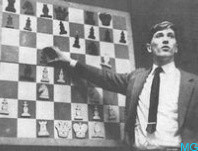
Bobby Fischer (born March 9, 1943) is a grandmaster and former world chess champion, who on September 1, 1972, became the first American chess player to win the FIDE World Chess Championship. In 1975, he officially lost the title when FIDE, the international chess federation, refused to accept his conditions for a title defense. Garry Kasparov wrote that of all world champions of chess, the skill gap between Fischer and his contemporaries was the largest in history . Fischer is also well known for his eccentricity, unconventional and irrational behavior, and outspoken political views. Despite his prolonged absence from competitive play, or perhaps because of it, Fischer is still among the best known of all chess players.
Fischer's victory over the Soviet champion Boris Spassky to win the world championship in the "Match of the Century" was seen as a symbolic victory for the West that catalyzed interest in the game internationally. His opponent was portrayed, in the United States in particular, as the product of an impersonal, mechanical, and oppressive system of state control, while Fischer was the solitary genius overcoming the Soviets' claim to dominance. As he was a national hero, Americans were willing to forgive his behavior and views as eccentricities, and in popular culture he became a symbol of the genius whose brilliance is so great that he is destroyed by it.